
The Johnson County Probate Division
Probate is handled by the Probate Division of the Johnson County District Court, on the first floor of the courthouse. The office is open 8:00 a.m. to noon and 1:00 p.m. to 4:30 p.m. Monday through Friday, and it closes for lunch. The clerk asks that business arrive by 11:45 a.m. and 4:15 p.m. District Judge Charles Droege presides over probate cases.
Care-and-treatment cases are handled separately, with District Judge Robert Wonnell presiding. Those cases often involve protected mental health information and are not treated as fully public. The Probate Division can be reached at 913-715-3370.
Probate Division
Johnson County District Court
150 W. Santa Fe St.
Olathe, KS 66061
913-715-3370
Mon-Fri 8 a.m.-noon, 1-4:30 p.m.
The county's Probate Division page lists the office location, judges, and forms.
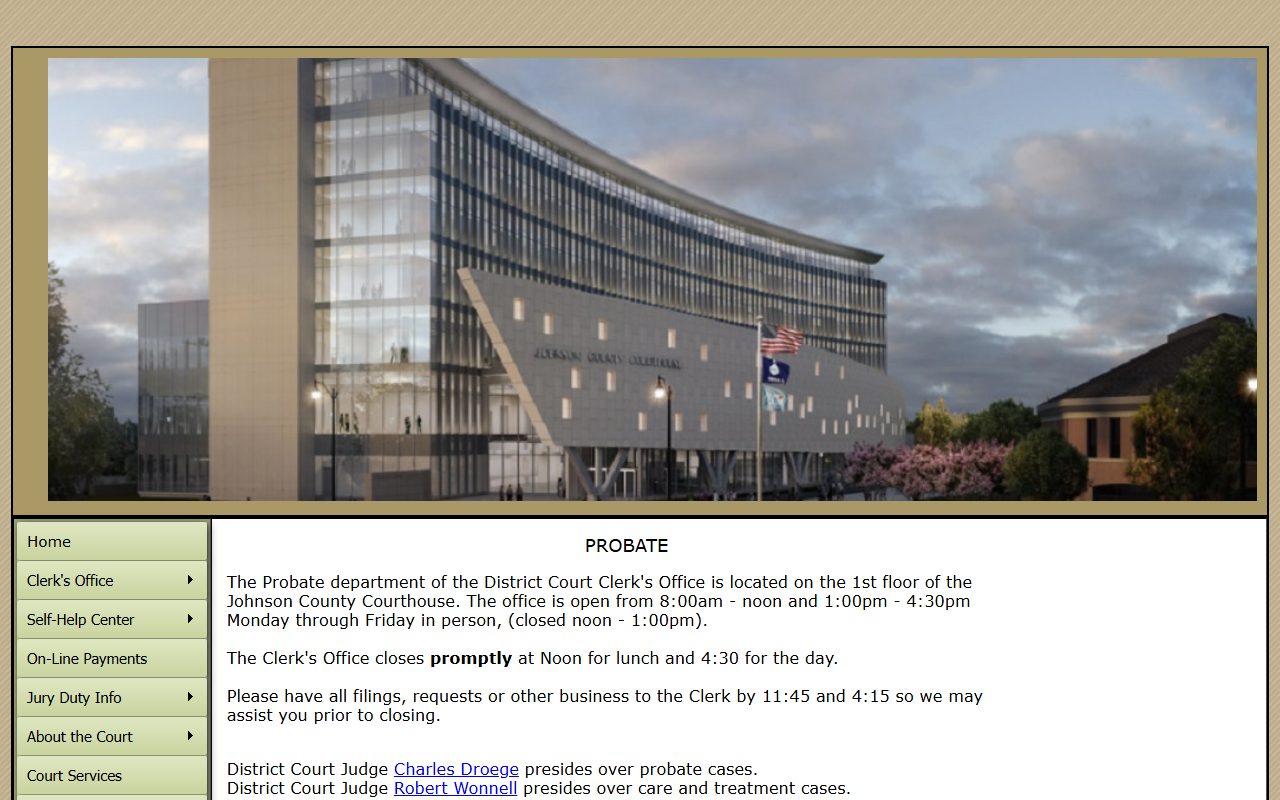
The page also sets out the small estate threshold and the filing methods.
What Probate Records Cover
Probate is the court process for estates, wills, and certain protective matters. In Johnson County it covers estate administration, will allowance, claims against an estate, guardianship and conservatorship, and adoption reports. Care-and-treatment cases also run through this part of the court, though they carry tighter privacy. The range is wide, from a simple will allowance to a long-running guardianship, so the forms and steps differ a great deal from case to case.
The division lists several common forms. Each ties to a specific step in handling an estate or a protective case. A guardianship protects the personal care of someone who cannot manage on their own, while a conservatorship handles their money, and the two can run in the same case.
- Small Estates Affidavit, for limited personal property transfers.
- Probate Notice of Hearing, when the court sets a hearing.
- Petition for Allowance of Demand, to make a claim against an estate.
- Report of Adoption, though adoption records themselves are restricted.
Common Probate Terms
Probate uses words that do not come up in daily life. A quick glossary helps you read a probate file or fill out a form correctly.
- Testator
- A person who makes a will.
- Executor
- The person named to carry out a will and settle the estate.
- Intestate
- Dying without a valid will, so state law decides who inherits.
- Guardianship
- Court authority over the personal care of another person.
- Conservatorship
- Court authority over another person's financial affairs.
The Small Estate Affidavit
Not every estate needs a full probate case. Kansas allows a Small Estates Affidavit to transfer certain personal property when the total value of the estate subject to probate does not exceed $75,000. The transfer is treated as one to the personal representative, and the receipt operates as a full discharge of the transferor.
There is a key catch the county flags directly. The Small Estates Affidavit does not get filed with the clerk's office. Many people assume every probate document is filed, so this is worth noting before you start. A small estate is not a full probate, and it skips the letters of administration step. When the property value goes over the threshold, a regular probate case is the right path instead.
How to File Probate Documents
Pro se probate filers can submit by fax, in person, or by mail. Download the forms, complete and save them, then submit to the Probate Division. Use the Notice of Hearing form when the court requires a hearing, and the Petition for Allowance of Demand for claims against an estate.
| Method | Instructions |
|---|---|
| Fax | Fax to 913-715-3405 with a payment slip if a fee applies; card adds $4.95 |
| In person | Probate Department, 150 W. Santa Fe St., Olathe, weekdays 8-noon and 1-4:30 |
| Clerk of the District Court, Probate Clerk, 150 W. Santa Fe St., Olathe, KS 66061 | |
| Payment is not accepted by email |
Note: Checks, money orders, or cashier's checks should be payable to the Clerk of the District Court.
Step-by-Step Probate in Johnson County
The order of steps matters in probate. Start by deciding whether the matter even needs a full case, then move through the forms in sequence. The division's own process points the way.
- Decide whether the estate is a small estate under the $75,000 threshold, which avoids a regular probate file.
- If filing a probate case, download the forms, complete them, and save them.
- Submit in person, by mail, or by fax with a payment slip if a filing fee applies.
- Use the Notice of Hearing form when the court requires a hearing.
- File a Petition for Allowance of Demand to make a claim against an estate.
- Search CaseSearch or a courthouse terminal for public probate records, expecting restrictions on adoption and care cases.
Keep in mind that the Help Center supports self-represented filers but cannot give legal advice on which path to take.
Claims Against an Estate
Creditors and others owed money by an estate use the Petition for Allowance of Demand to make a claim. The claim is filed in the estate's probate case, and the court decides whether to allow it. A Notice of Hearing may follow when the court sets the matter for a date.
Because a claim becomes part of the estate file, it is generally part of the public District Court record unless sealed. Anyone tracking an estate can search the case in the statewide portal to see filed claims, hearings, and orders as they post.
Searching Probate Records in CaseSearch
Probate case records are part of the District Court record. Search them in Kansas eCourt CaseSearch or on a public terminal at the courthouse, unless a record is restricted. A smart habit is to search first and file second, so you do not open a duplicate case for an estate that already has a file.
For the full search steps and case number formats, see the Johnson County court records page. Probate cases use the same statewide system as other District Court cases.
Restricted Probate Records
Some probate-related records are closed. Adoption records are listed on the probate page, but adoption records are a restricted category under Kansas court access rules. Care-and-treatment matters involve confidential mental health information and are not fully public. The Kansas Open Records Act exemptions in K.S.A. 45-221 cover several closed categories.
The KORA exemptions are set out in K.S.A. 45-221.
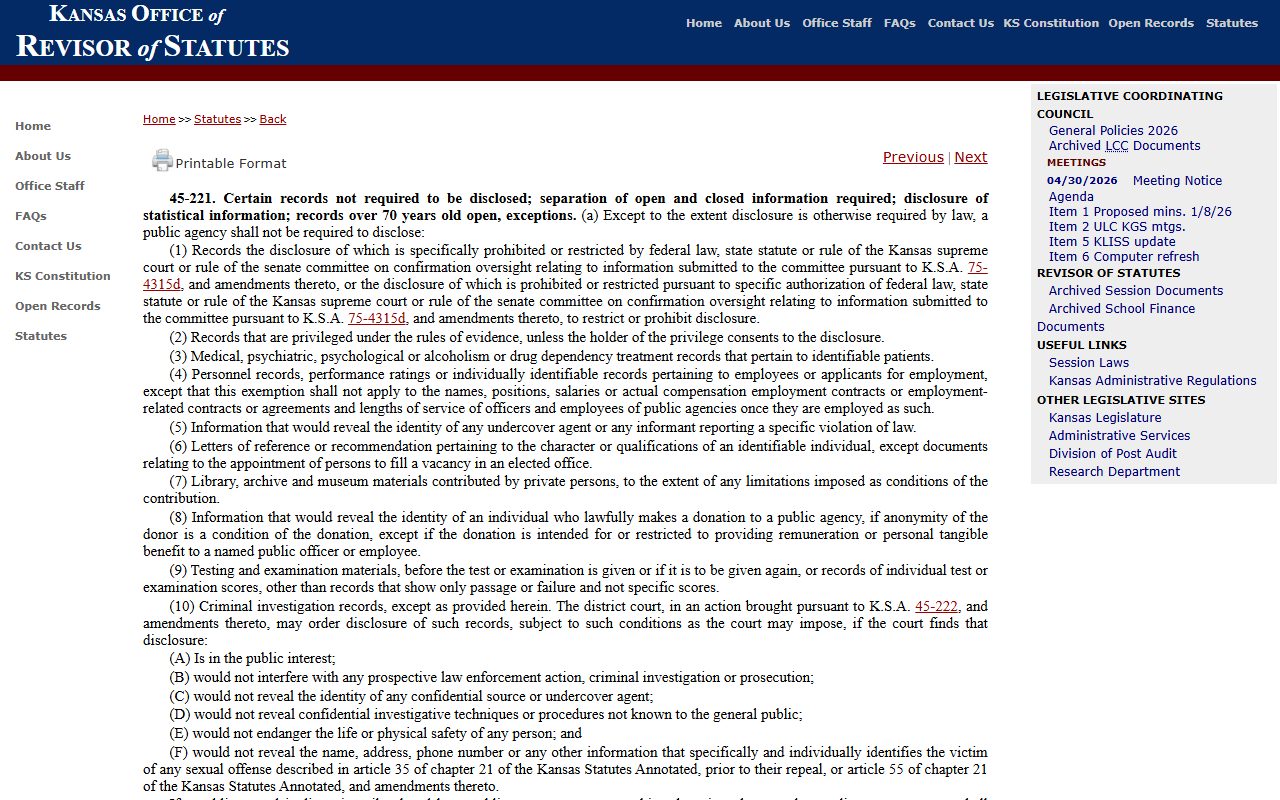
The wider open-records framework starts with the Kansas Open Records Act article index.
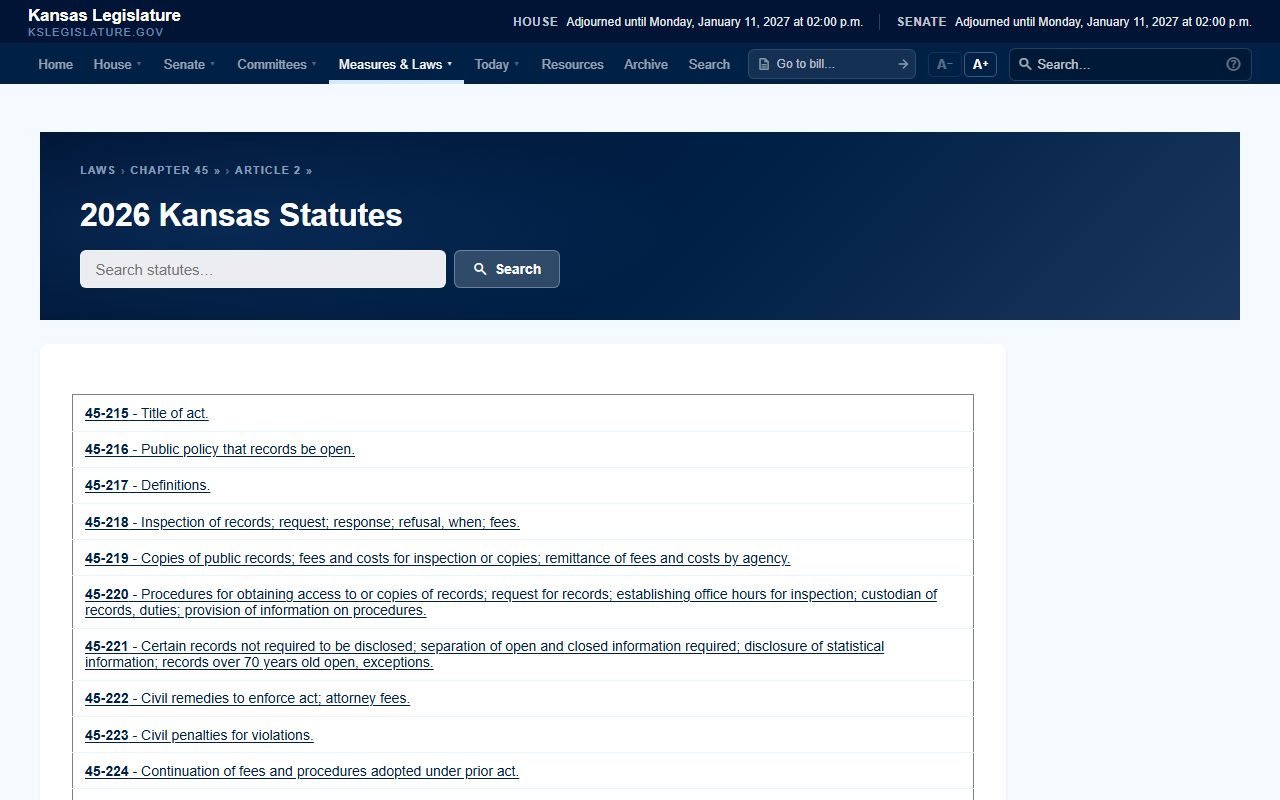
The Kansas Open Records Act article index lists the statutes that govern access.