
Arrest Records in Johnson County
Arrest records are created by law enforcement, mainly the Johnson County Sheriff's Office and city police. When a person is booked, the jail logs identity details, the arresting agency, the booking date and time, and the charges. The Sheriff runs Central Booking at 101 North Kansas Avenue in Olathe, where all county law enforcement agencies can bring arrestees. That booking data is what feeds the public arrest and inmate tools.
An arrest record differs from a criminal court record. The arrest record is the booking snapshot. The court record begins only when the District Attorney files charges, and it tracks the case to its end. For the full case history, charges, and disposition, see Johnson County court records. This page leads with arrest and booking data, then points to the court file for the rest.
How to Search Johnson County Arrest Records
The Sheriff publishes the main tools. The inmate search shows current custody and three years of prior booking history. The booking and release report shows who was booked and released over the last week. Both are free and need no account.
- Open the Sheriff inmate search and enter a last name and first name.
- Choose current custody, or switch to the three-year previous booking history option.
- Open a result to view booking details, charges, and bond.
- Check the booking and release report for recent arrests by date.
Use the Sheriff inmate search portal for named people. For a fuller walkthrough of the roster and result fields, see Johnson County inmate records. Statewide criminal history is a separate search through the Kansas Bureau of Investigation.
Arrest Records vs. Criminal Court Records
An arrest happens at booking. A court record starts when charges are filed. The two records live with different offices and hold different fields. Records Management at the courthouse says plainly that it does not provide arrest records or police reports, and directs people to the arresting agency for those.
| Arrest Record | Criminal Court Record | |
|---|---|---|
| Source | Sheriff or city police | District Court clerk |
| Created When | At booking | When charges are filed |
| Contents | Booking data, charges, bond, mugshot | Pleadings, motions, disposition |
| Where to Search | Sheriff inmate and booking tools | Kansas eCourt CaseSearch |
Charges vs. Convictions
Being charged is not the same as being convicted. A charge is an accusation that needs only probable cause. A conviction needs proof beyond a reasonable doubt, by plea or verdict. Many arrests never lead to a conviction. A case can be dismissed, diverted, or end in a not-guilty finding, and the arrest record can still exist.
| Charge | Conviction | |
|---|---|---|
| Stage | Accusation at or after arrest | Verdict or guilty plea |
| Burden of Proof | Probable cause | Beyond a reasonable doubt |
| Public Record | Yes, unless restricted | Yes, unless expunged |
The District Court publishes a criminal court cost table, which shows fees by case level.
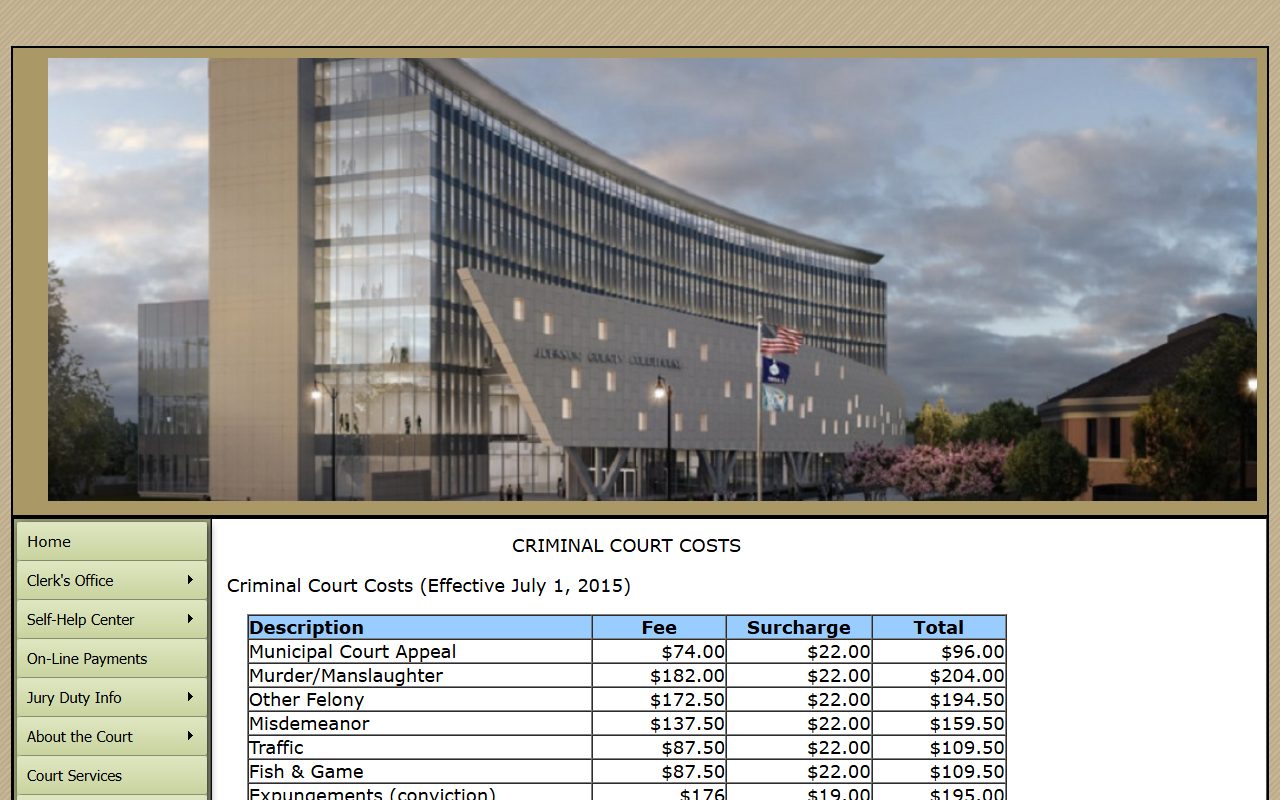
The court's criminal court costs page lists totals such as $159.50 for a misdemeanor and $109.50 for traffic.
Sealed vs. Expunged Records
Sealed and expunged records are both closed to the public, but they are not identical. A sealed record is hidden from public view by statute, rule, or order. An expunged record is treated as if it never occurred for most outside purposes. In Kansas, adult expungement runs under K.S.A. 21-6614 for convictions and diversions, and under K.S.A. 22-2410 for arrests with no charge, a dismissal, or a not-guilty result.
| Sealed | Expunged | |
|---|---|---|
| Visibility | Hidden from public view | Treated as if it never occurred |
| Law Enforcement | Limited access | Very limited access |
| Eligibility | By statute, rule, or court order | Set waiting periods under K.S.A. 21-6614 and 22-2410 |
Johnson County's criminal expungement page lists the $195 filing fee and the forms.
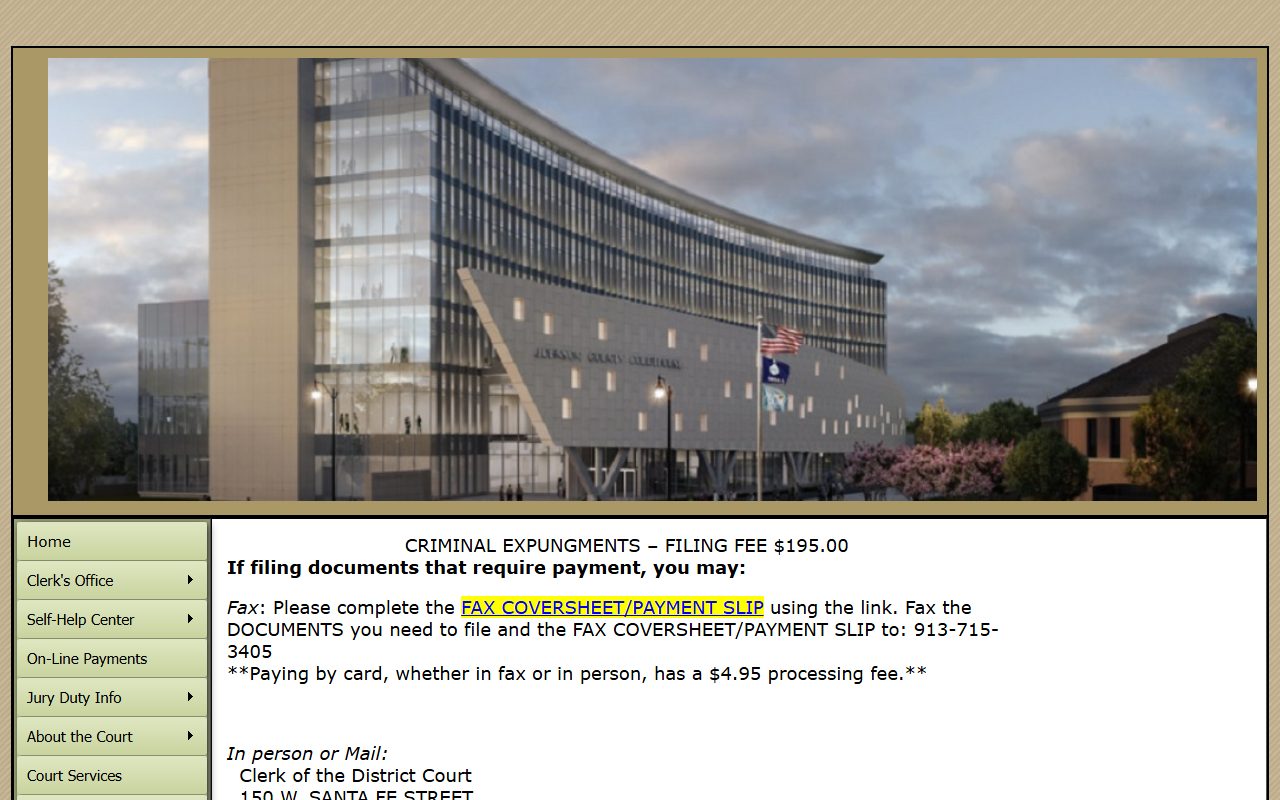
Some serious crimes cannot be expunged, so eligibility depends on the offense and the waiting period.
Mugshots and Booking Photos
Mugshots show up in the Sheriff's inmate search detail view, displayed when one is available. The booking and release report can also show a mugshot button when an image exists. The public inmate search shows a person's year of birth rather than a full date, and it does not expose sensitive fields like Social Security numbers.
A mugshot reflects an arrest, not a finding of guilt. The same caution from the charges-versus-convictions section applies here. If a case is later dismissed or expunged, the public booking entry may still surface, which is one reason the expungement process matters.
Statewide Criminal Records Search
For a statewide record rather than a single county booking, use the Kansas Bureau of Investigation. The District Court directs background-check requests to KBI at 785-296-8200 or to the FBI for federal checks. KBI runs an official criminal history record check portal, which is the proper source for a statewide name-based search.
The KBI criminal history portal is the official statewide tool, and it charges a fee per search. County booking tools, by contrast, only show activity within Johnson County. For records held in the state prison system, the inmate pages cover the KDOC KASPER search.
Keep the sources straight. The Sheriff shows local booking. The District Court shows the local case. The KBI shows a statewide criminal history. No single county tool gives a full statewide picture, so a serious background question usually needs the KBI portal plus the relevant court file.
Diversion and Specialty Court Outcomes
Not every arrest ends in a standard conviction. The District Attorney runs diversion programs that can lead to dismissal once a person completes the terms. Johnson County also runs a Veterans Treatment Court, a 12 to 18 month program with frequent court appearances, testing, and treatment, offered as an alternative to jail for eligible veterans.
These outcomes change what an arrest record looks like over time. A diverted case may show as diverted, then dismissed. That is why a booking entry alone does not tell the whole story, and the matching court file fills in the result.
Background Check Considerations
There is a difference between a casual public-records lookup and a formal background check. Employment, tenant, and credit screening must follow the federal Fair Credit Reporting Act, which uses regulated consumer reporting agencies. Free Sheriff and court tools are public records for general information, not FCRA-compliant screening.
Important: This site is not a consumer reporting agency under the FCRA, and its information may not be used for employment, tenant, credit, or insurance decisions.
Juvenile Criminal Records in Johnson County
Juvenile records are handled apart from adult records and are largely closed. The District Attorney's Juvenile Division handles reports for youth ages 10 through 17. In 2024 the office received over 1,900 juvenile reports and filed 960 juvenile offender cases, with 299 felony and 661 misdemeanor charges. Many of those resolved through Immediate Intervention or diversion.
Most juvenile and child-in-need-of-care records are not public under K.S.A. 38-2309. A juvenile adjudication is not a conviction, and juvenile records can be expunged after at least two years from discharge in many cases. The court's juvenile expungement page lists that process.
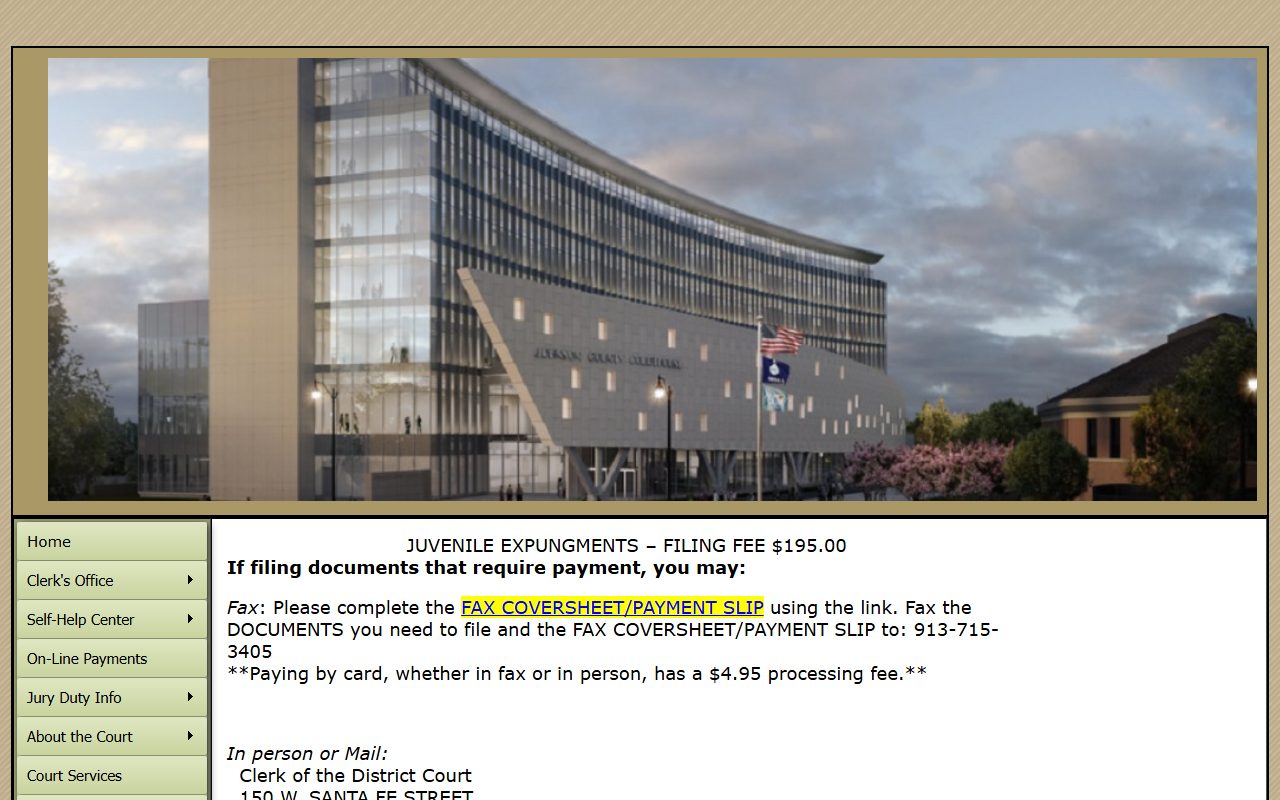
The juvenile expungement page sits beside the adult expungement forms.
Expungement Under Kansas Law
The controlling statute for adult conviction and diversion expungement is K.S.A. 21-6614. It sets waiting periods, lists offenses that cannot be expunged, and routes granted orders to the KBI and other agencies. The statute also touches firearm-right considerations for some expungements. Filing happens in the convicting court, which for Johnson County cases is the District Court in Olathe.
An expungement is filed by fax with a payment slip, in person, or by mail to the Clerk of the District Court. Payment is not accepted by email. Once granted, the record is treated as closed for most outside purposes.
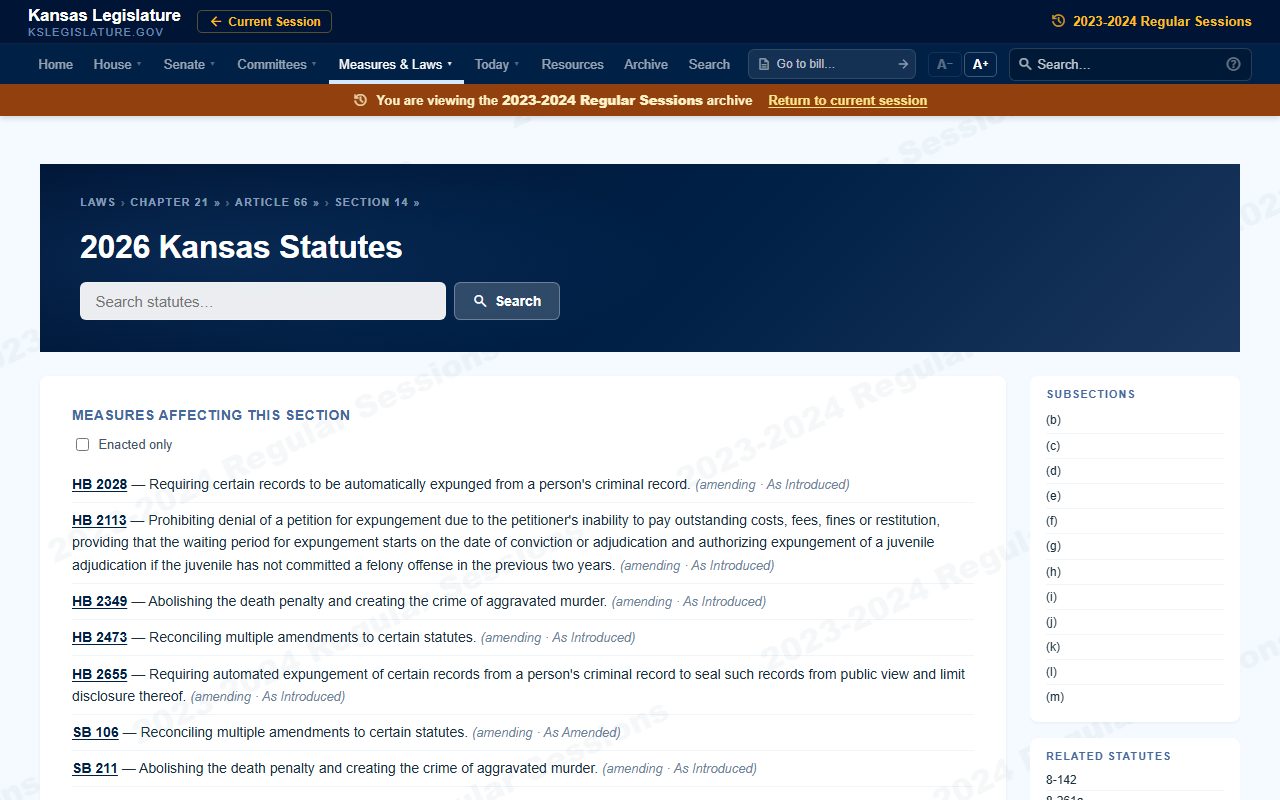
You can read the law at K.S.A. 21-6614 on the Kansas Legislature site.