
What Is a Court Docket in Johnson County
A docket, sometimes called the register of actions, is the timeline of a case. It lists each filing, motion, order, hearing, and continuance in date order. It does not hold the full text of every document, but it tells you what happened and when. Think of it as the table of contents for a case file. Each line points you to the next step, and together the lines show the whole path of the case.
The docket differs from the full case record. The docket is the list of events. The full record holds the actual pleadings, orders, and judgments. In Johnson County, both live in the same Kansas eCourt system, but the docket is what you scan first to see where a case stands.
How to Find Johnson County Dockets Online
Docket entries are viewed through Kansas eCourt CaseSearch, the statewide portal Johnson County joined on November 5, 2024. You can reach a docket by name or by case number. When a case is not online, a public terminal at the courthouse shows the same record at no charge for viewing.
- Open Kansas eCourt CaseSearch at the official Kansas Judicial Branch site.
- Search by party name, or enter a case number in the new JO-YYYY-CR-123456 format.
- Open the matching case to load its docket, or register of actions.
- Read the entries in date order and note any upcoming hearing dates.
The portal is Kansas eCourt CaseSearch. Federal dockets are separate and run through PACER for the U.S. District Court for the District of Kansas.
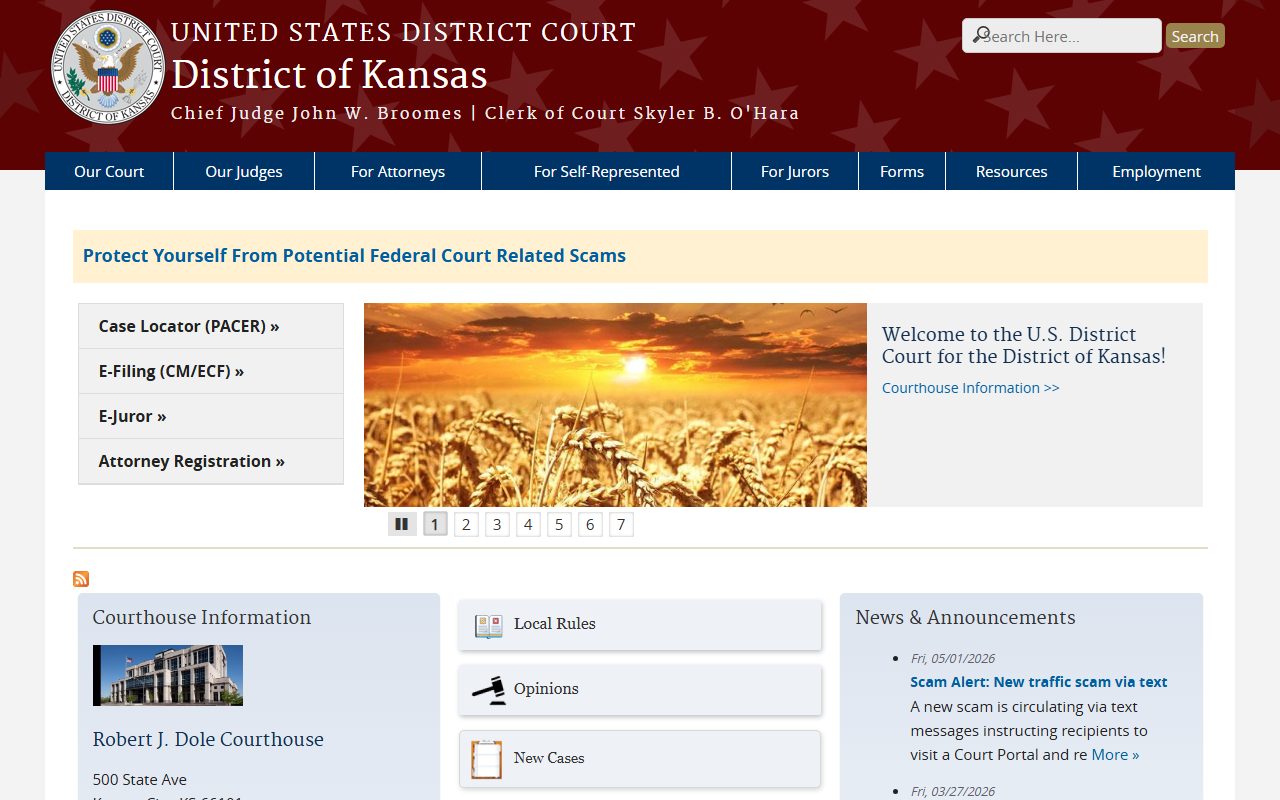
Federal cases for Johnson County residents are filed in this court, not in the county district court.
Sample Johnson County Docket Entry
Each docket line follows a pattern. It shows when something happened, what it was, and who filed it. Some entries link to a document; others are just events like a hearing or a continuance.
| Field | What It Shows |
|---|---|
| Entry Date | The date the clerk recorded the filing or event |
| Event Type | Motion, order, hearing, notice, judgment, or warrant |
| Party Filing | Which side filed the document or requested the action |
| Hearing Data | Date, time, courtroom, and division or judge |
| Document Link | A link to the public document, when one is posted |
Note: A first appearance date listed in a jail record should be confirmed in CaseSearch after 11:00 a.m., since court times can change.
Courts and Divisions That Publish Dockets in Johnson County
Johnson County District Court runs more than two dozen divisions, each with an assigned judge and courtroom. Dockets flow from these divisions into the statewide system. Municipal courts and the federal court keep their own separate dockets.
- District Court divisions: civil, criminal, family, probate, and juvenile matters.
- District magistrate divisions: traffic, small claims, and limited actions.
- Municipal courts: city ordinance and local traffic cases.
The court's phone directory lists each division, judge, courtroom, and clerk unit.
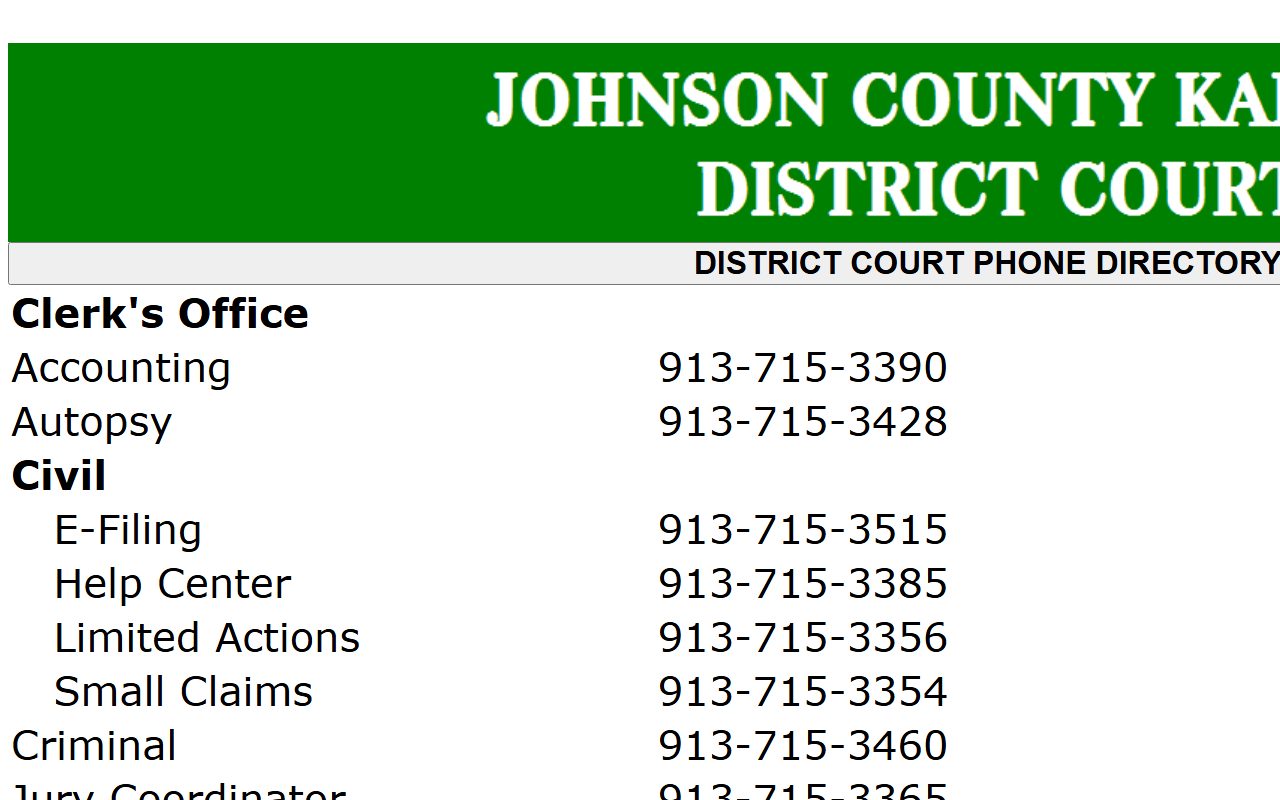
The directory below maps each division to its judge and courtroom number.
| Division | Judge | Courtroom |
|---|---|---|
| Division 8 | Chief Judge Droege | 7E |
| Division 1 | Judge O'Grady | 7A |
| Division 6 | Judge Wonnell | 4E |
| Division M2 | Judge Wayne Smith | 2B |
| Division M4 | Judge McEntee | 2A |
Division M2 handles traffic and criminal first appearances in Room 2B, with criminal first appearances at 1:30 p.m.
Docket vs. Full Case Record
The docket and the full case record are not the same thing. The docket is a list of events you scan to track progress. The full record is the set of actual documents you read for legal detail or evidence. You often start with the docket, then request the documents you need.
| Docket | Full Case Record | |
|---|---|---|
| Format | List of dated entries | Full documents and orders |
| Access | Often online and free to view | May require a copy fee or a courthouse visit |
| Use | Track case progress and dates | Legal review and evidence |
To pull the documents behind a docket, use the copy request steps on the Johnson County court records page.
How to Read a Johnson County Docket
Docket lines use shorthand. A motion is a request to the judge. An order is the judge's ruling. A continuance moves a hearing to a later date. A bench warrant often follows a missed appearance. The disposition line tells you how a charge or case ended.
Disposition codes matter most. Dismissed means the case ended without a finding. Diverted means an agreement may lead to dismissal. A conviction or judgment is the final result. If a docket entry is unclear, the clerk cannot interpret it for you or decide whether a judgment is still owed.
Audio of a recorded hearing can be requested through the court's KORA and audio process. A separate request is needed for each hearing, and the cost is $50 per hearing, up to one day in length. Not every hearing is recorded, though. When there is no recording, a written transcript can be requested from the managing court reporter instead.
Party roles also help you read a docket. Civil cases list a plaintiff and a defendant. Criminal cases list the State against a defendant. Family and protection cases use petitioner and respondent. Probate cases name a decedent and interested parties. Matching the role to the entry tells you who acted and what the court did next.
Hearing Dates and Continuances on the Docket
The docket is where you confirm a court date. Each hearing entry shows the date, time, courtroom, and division. Because Johnson County now uses both virtual and in-person hearings, the assigned judge decides how a case is heard, and virtual hearings run on Zoom. Check the docket close to the date, since settings move.
Continuances appear as their own entries. A continuance pushes a hearing to a later date, and it shows who asked for it. In traffic matters, the court grants a set continuance window, then expects the case to be resolved, pleaded, or set for trial. If a party misses a date, the docket may then show a bench warrant or a failure-to-appear entry, which can carry real consequences.
For dates tied to someone in custody, the docket and the jail record may differ for a short window. The jail record notes that first appearance times can change and should be verified through the court portal after late morning on the hearing day.
Sealed and Restricted Dockets
Not every docket is open. Sealed cases do not appear in public results. Many juvenile and child-in-need-of-care dockets are closed, and adoption matters are restricted. Care-and-treatment cases, which involve protected health details, are not treated as fully public. The Kansas Judicial Branch lists these categories as outside public access.
When a docket is sealed, even the list of events is hidden, not just the documents. A person with a legal right or a court order may still gain access. For criminal cases that were expunged, the docket is treated as closed, and the path to limit access runs through the expungement process described on the arrest records page.