
How to Search Johnson County Court Records
Johnson County District Court records are searched through Kansas eCourt CaseSearch. The county moved to this statewide system on November 5, 2024, and it was the last Kansas county to do so. CaseSearch holds both historical cases and new filings. You can look up a case by party name or by case number. If you cannot find a file online, the courthouse keeps public terminals where you can search at no cost when you only view records.
Have a few details ready first. A full name helps, and a case number helps more. Case numbers come in two styles, so check the format before you assume a search failed.
- Open the public portal at the Kansas Judicial Branch site, not a private data broker.
- Enter a party name, or paste a case number if you have one from a court notice.
- Try the new statewide number format, then a name search if the number does not match.
- Review the docket entries, parties, hearing dates, and disposition.
- Request a certified copy from Records Management if you need one for legal use.
The official portal is Kansas eCourt CaseSearch. The Sheriff's Office also posted a helpful note on the eCourt migration and the old and new case number formats. Older Johnson County cases used a format like YYCR12345. The new statewide format looks like JO-YYYY-CR-123456. If a case number has zeros, keep them.
Here is the migration notice and clerk hours posted on the local court site, which still guides daily use of the system.
The District Court eCourt migration notice lays out the move to CaseSearch and the clerk's hours.
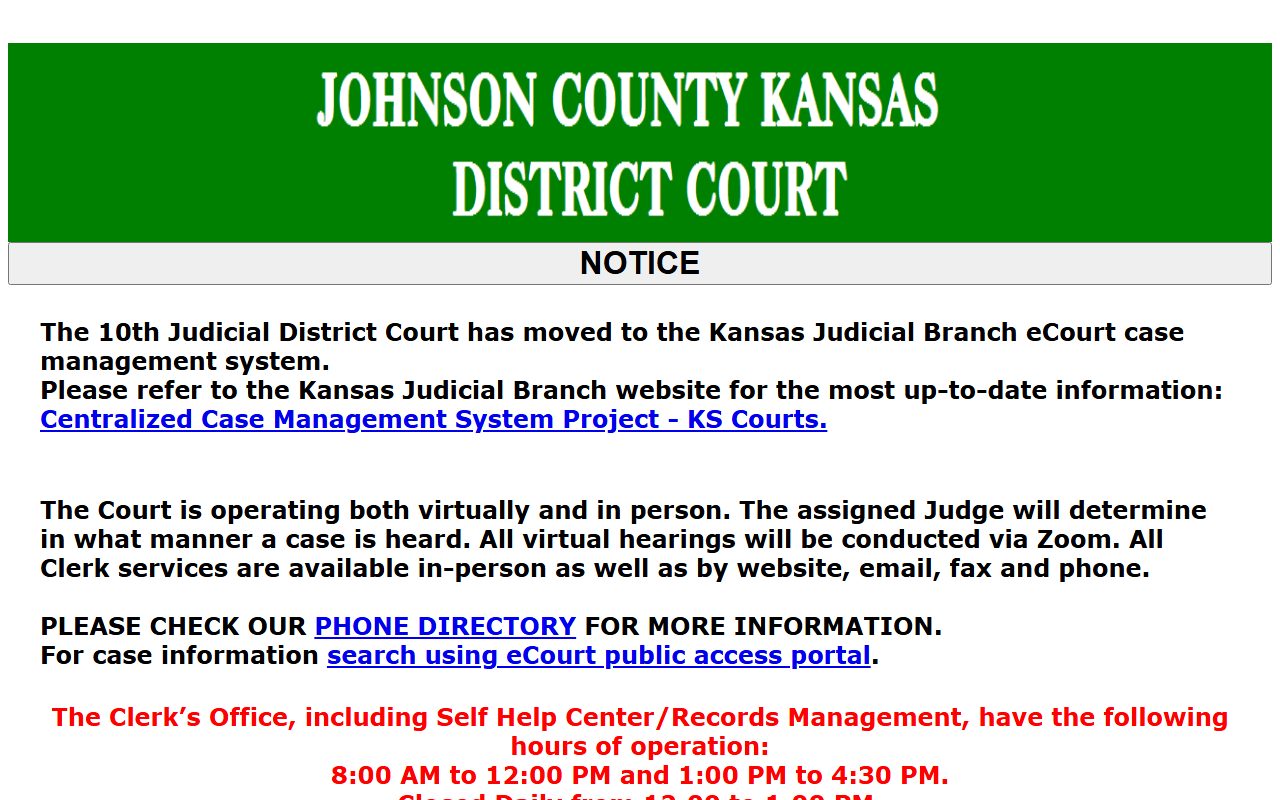
The notice confirms that historical and new cases are now searched through the statewide portal.
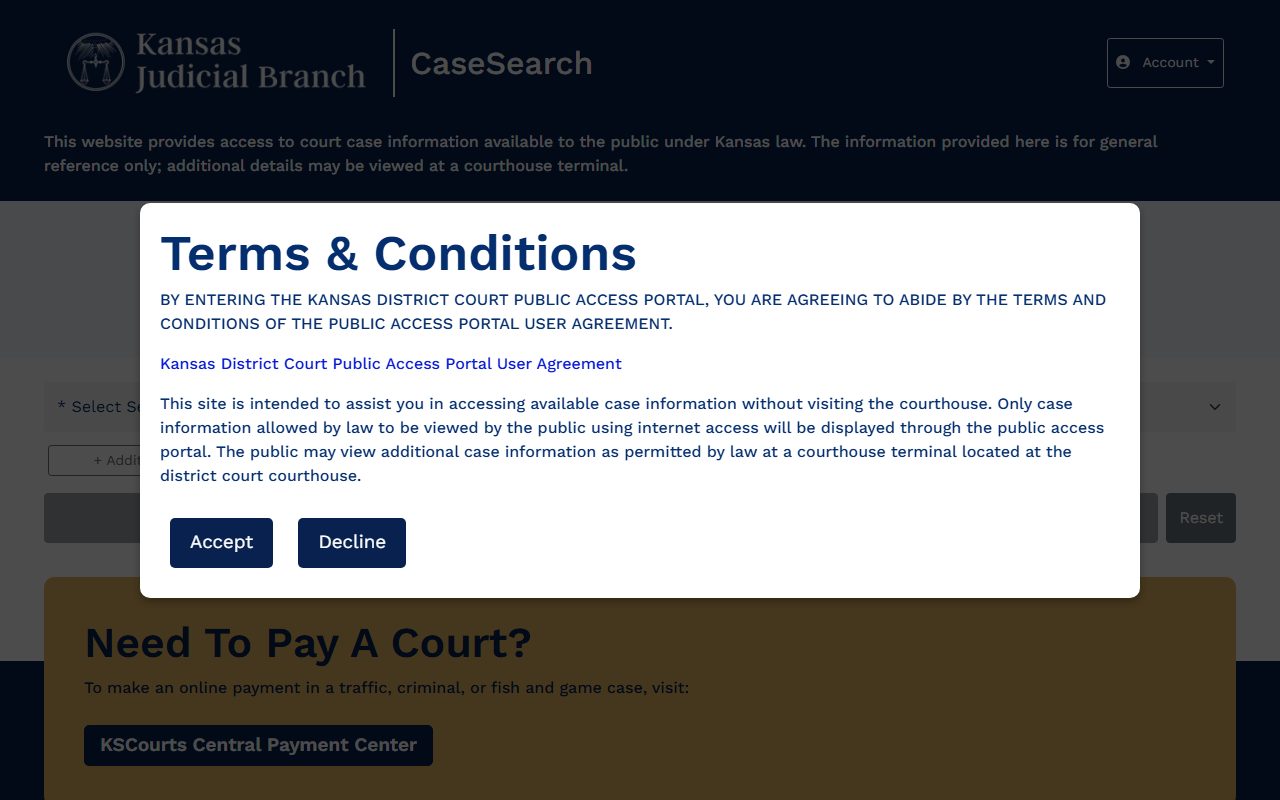
The portal screen above is where most Johnson County court records searches now begin.
The Johnson County Judicial System
Kansas runs a unified court system. The Kansas Supreme Court sits at the top and has administrative authority over all state courts. The Kansas Court of Appeals is the middle appellate court. District courts are the main trial courts, and they hear nearly every kind of case. Johnson County is the 10th Judicial District, and its District Court handles civil, criminal, domestic, probate, juvenile, small claims, limited actions, traffic, protection order, and care-and-treatment matters.
Municipal courts are separate. They are city courts for local ordinance and traffic cases. A person convicted in a municipal court can appeal to the district court of that county. The Chief Judge of the 10th Judicial District is James Charles Droege, and the court lists more than 20 district judges plus several district magistrate judges.
Case flow: Municipal Court › District Court › Kansas Court of Appeals › Kansas Supreme Court
| Court | Jurisdiction | Case Types |
|---|---|---|
| Kansas Supreme Court | Highest appellate | Direct appeals in serious cases; review of appeals court rulings |
| Kansas Court of Appeals | Intermediate appellate | Most civil and criminal appeals from district courts |
| Johnson County District Court | General trial court | Civil, criminal, family, probate, juvenile, traffic, small claims |
| Municipal Courts | City ordinance courts | Local ordinance and minor traffic offenses |
For a fuller view of the state structure, the Kansas Judicial Branch keeps an overview of the court system.
That overview shows how district courts like Johnson County's fit under the appellate courts.
Johnson County Courthouse and Offices
The main courthouse is in downtown Olathe. It sits across Santa Fe Street, north of the County Administration Building and west of Olathe City Hall. The building is seven stories and about 356,821 square feet, with 28 courtrooms, the District Attorney, the District Court Trustee, and the Law Library inside. The county location page lists the address and main phone, and the Sheriff's Court Security Division screens every person who enters.
The county's courthouse location page gives the building size, hours, and the departments housed there.
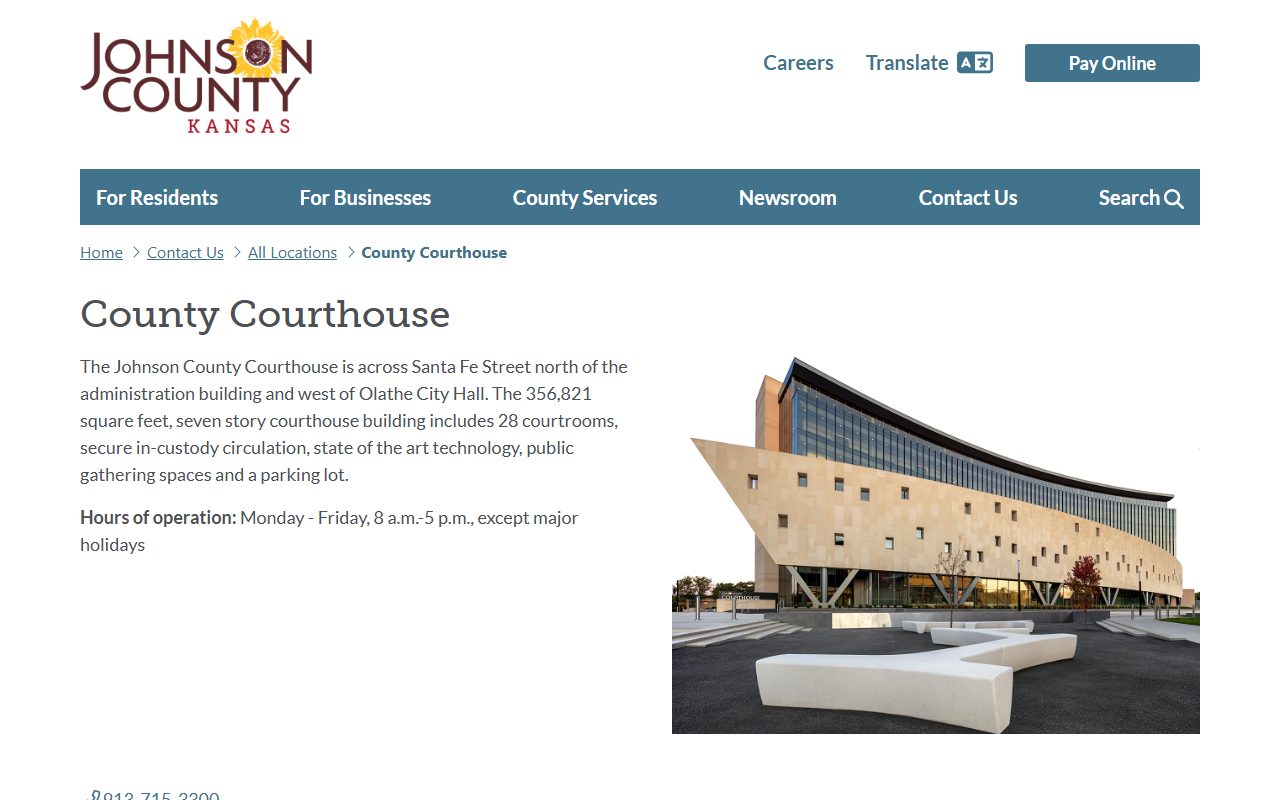
Plan around security screening and limited two-hour street parking before a hearing.
Types of Court Records Available in Johnson County
The District Court produces several record types. Each one ties to a different division of the court, and the clerk routes filings to the right desk. Civil, criminal, family, probate, juvenile, and traffic files all live inside the same case management system, but access rules differ by type.
The court's own legacy site still lists these workflows, which shows how it treats each as a separate path for the public.
- Criminal records - felony, misdemeanor, and criminal traffic cases handled by District Court criminal divisions.
- Civil records - lawsuits, judgments, garnishments, liens, limited actions, and small claims.
- Family and divorce records - divorce, parentage, support, and parenting plans through the Self-Help Center.
- Probate records - estates, wills, guardianship, conservatorship, and care-and-treatment matters.
- Traffic records - state citation cases, diversion, and payment matters.
The legacy District Court site still links local pages for records, marriage, probate, and traffic.
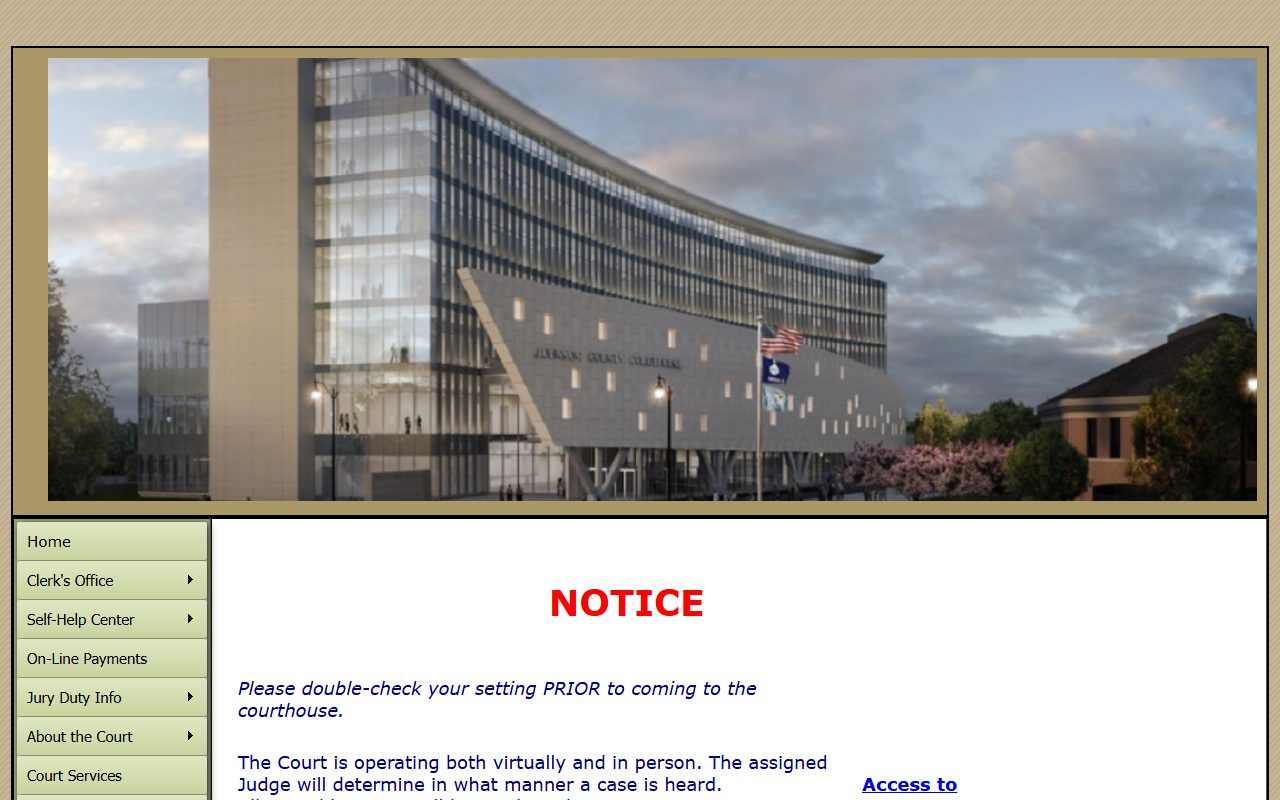
Those local pages remain useful even after the move to the statewide system.
What Johnson County Court Records Show
A case file is built from a set of fields. Once you find a case, the docket lists each filing and event in order. The fields below appear in most Johnson County District Court records, though sealed items and confidential identifiers are removed from public copies.
| Field | What It Shows |
|---|---|
| Case Number | Old format like YYCR12345 or new statewide format like JO-YYYY-CR-123456 |
| Filing Date | Date the clerk received and filed the petition or charge |
| Parties | Plaintiff and defendant, or petitioner and respondent, by case type |
| Charges / Cause | The criminal charge or the civil cause of action |
| Disposition | How the case was resolved: dismissed, diverted, convicted, or pending |
| Sentence / Judgment | The final order, sentence, fine, or money judgment |
Note: First appearance dates shown in jail records should be confirmed in CaseSearch after 11:00 a.m. because hearing dates and times can change.
Public Access Laws for Johnson County Court Records
Kansas public records are governed by the Kansas Open Records Act, or KORA. Court access also depends on Supreme Court rules, orders, and statutes that protect juvenile, adoption, expunged, and victim information. Johnson County District Court says KORA lets the public inspect and copy public records, but not every court record is open. The Court Administrator serves as the Freedom of Information Officer, and a requester is entitled to a response within three business days.
Key Statutes:
K.S.A. 45-215 et seq. - the Kansas Open Records Act, the base law for public record access.
K.S.A. 45-221 - lists records that are exempt from open access, such as criminal investigation files.
K.S.A. 21-6614 - lets eligible people petition to expunge adult convictions, arrests, or diversions.
Audio of a hearing costs $50 per hearing, up to one day in length. Copies may be charged at staff-time cost plus no more than $0.50 per page.
Records That Are Restricted or Confidential
Some Johnson County court records are closed to the public. The Kansas Judicial Branch lists adoption records, expunged criminal records, many juvenile and child-in-need-of-care files, and grand jury proceedings as not available. Care-and-treatment cases often hold protected mental health details. Certain criminal investigation records and victim identifying information are also restricted.
To view a sealed record, a person usually needs a statute-specific right or a court order. Expungement is the path to limit public access to an eligible record. The county's criminal expungement page lists the forms and fees and points to the controlling statutes.
Specialty Courts in Johnson County
Kansas allows judicial districts to run specialty courts. These are treatment and problem-solving programs for issues like addiction or mental illness. Johnson County's confirmed specialty court is the Veterans Treatment Court, which serves the 10th Judicial District. It is a 12 to 18 month program with frequent court appearances, drug and alcohol testing at least twice a week, treatment, recovery meetings, and a veteran mentor. The program offers a probation track through Court Services and a diversion track through the District Attorney.
The District Attorney's Office also runs diversion programs and has worked on strategies to keep seriously mentally ill people out of jail. Its work shows up across criminal, traffic, and juvenile matters.
The county's District Attorney office page outlines the divisions and featured resources.
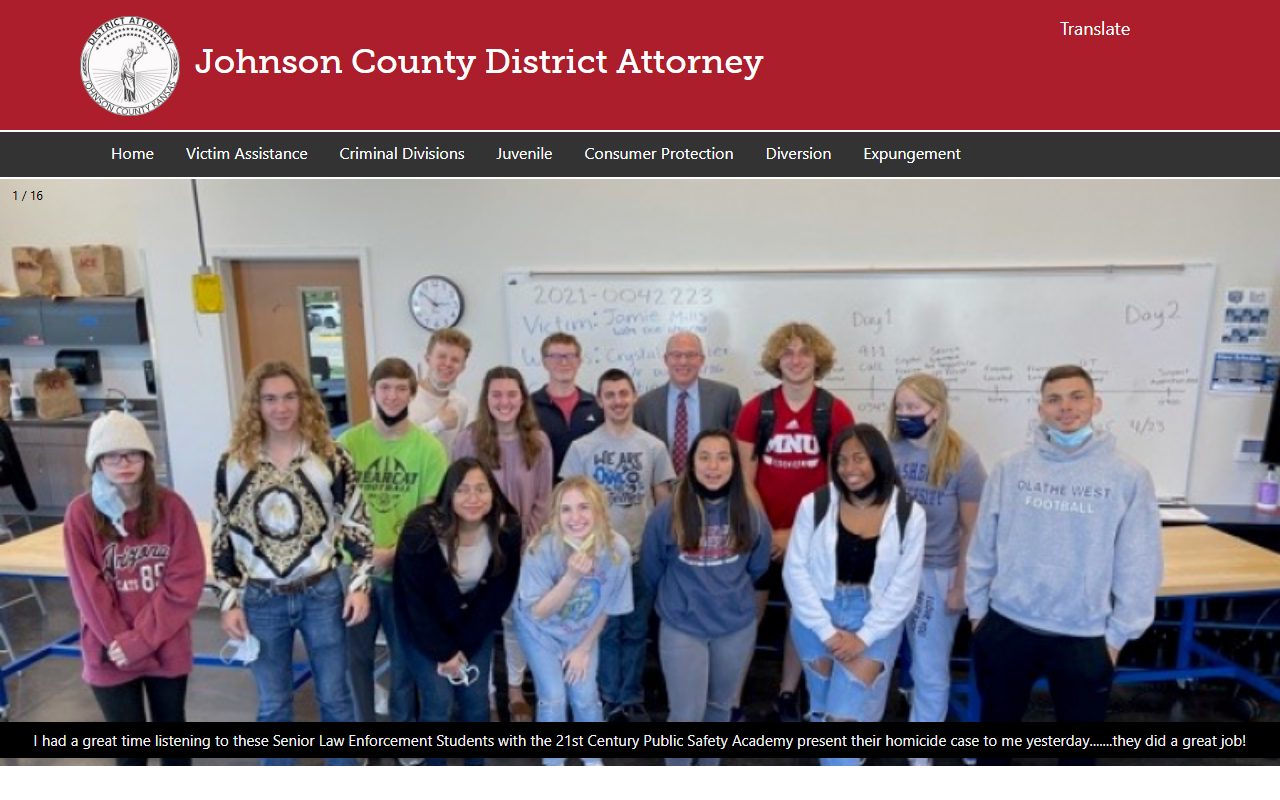
District Attorney Stephen M. Howe leads the office for the 10th Judicial District.
Johnson County Sheriff and Jail
The Johnson County Sheriff's Office is led by Sheriff Byron K. Roberson. It employs more than 450 sworn deputies and over 125 civilian staff, and it runs two adult detention centers. Central Booking sits at 101 North Kansas Avenue in Olathe, and the New Century Adult Detention Center sits at 27745 West 159th Street in New Century. The jail system holds 1,081 beds. The Sheriff publishes free public tools for inmate searches, booking and release reports, and active warrants.
For the full roster details, see Johnson County inmate records, check released inmates for recent releases, and use warrant records for active warrants. The county's Sheriff department overview describes the agency's size and divisions.
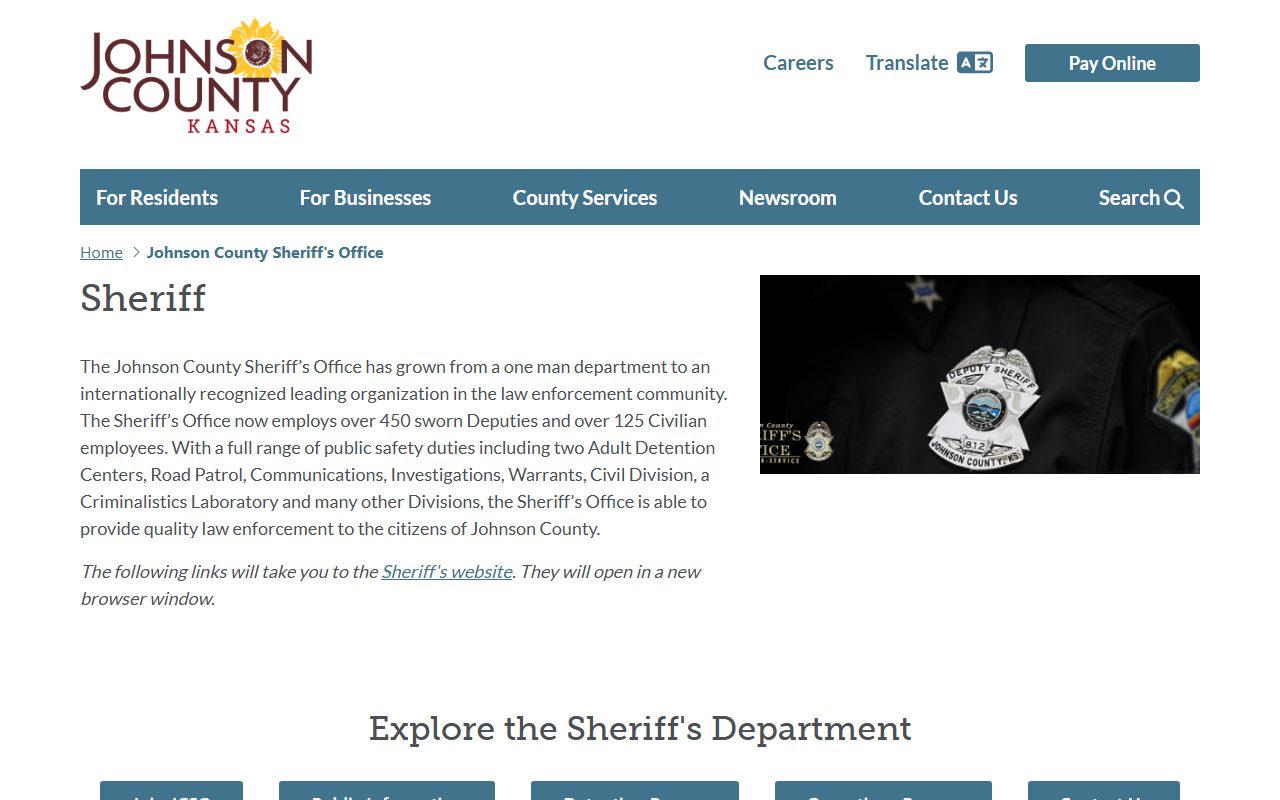
The Sheriff's public information tools are unusually detailed at the field level.
You can also start from the Sheriff public information home, which links the search tools directly.
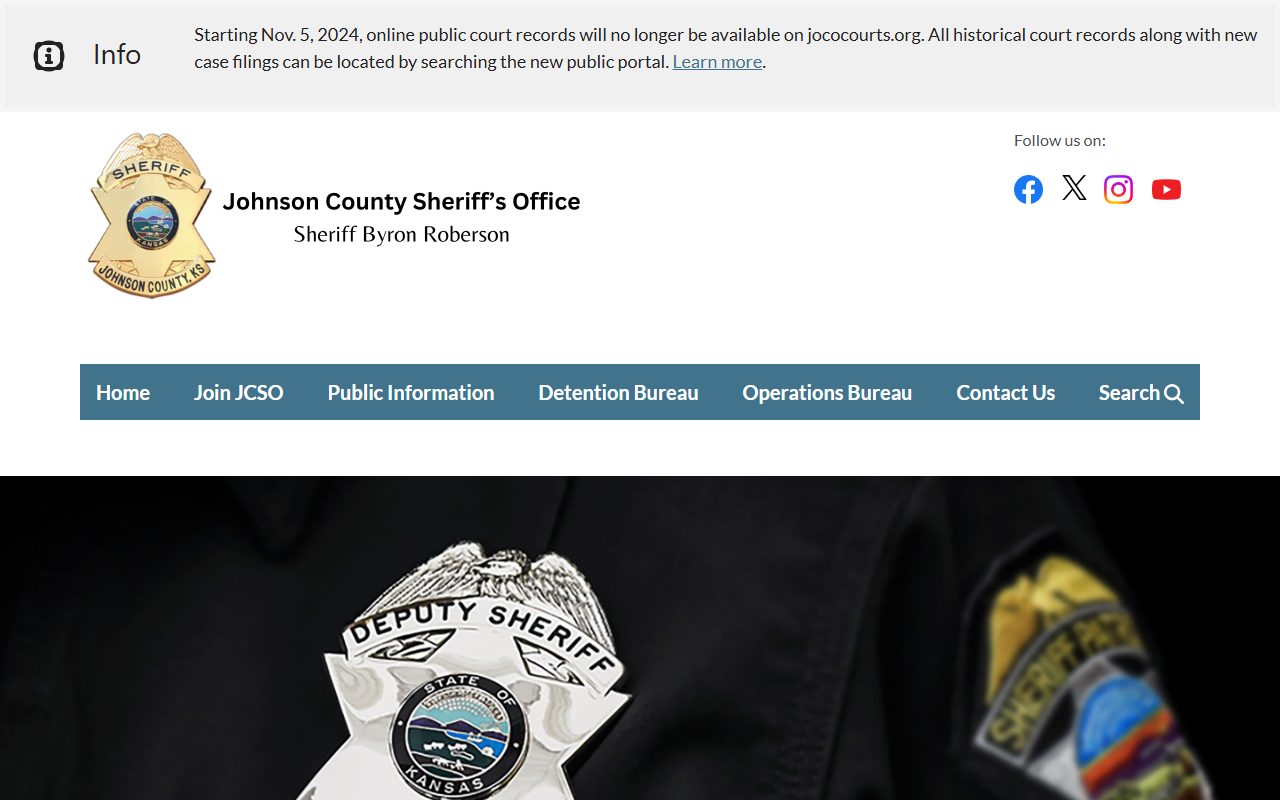
From that page the inmate, booking, and warrant searches are one click away.
Marriage, Divorce, and Probate Records
Marriage license applications in Johnson County are online only through the state portal, and the fee is $85.50 plus a small processing charge. Divorce is filed through the District Court Self-Help Center. Probate is a division of the District Court, not a separate courthouse. For more, see marriage and divorce records and probate records.
- Testator
- A person who makes a will.
- Executor
- The person named to carry out a will and settle the estate.
- Conservator
- A person given court authority over another person's financial affairs.
Johnson County Court Records Fees
Fees depend on what you ask for. Viewing records at a public terminal is free when you do not order copies. Copies, archived searches, and audio carry set charges. The clerk asks you to call for a price quote before you submit a copy request.
| Item | Amount |
|---|---|
| Public record copies (KORA) | Up to $0.50 per page plus staff time |
| Pre-1980 case search | $12.00 pre-payment, no personal checks |
| Audio of a hearing | $50 per hearing, up to one day |
| Criminal expungement filing | $195.00 |
Note: Fines, restitution, and payment plans can change a total, so confirm any amount owed with the clerk before you pay.
How to Interpret Johnson County Court Records
Court records use shorthand. A charge is not a conviction. A disposition tells you how a charge ended, whether by dismissal, diversion, plea, or verdict. The docket, sometimes called the register of actions, lists each motion, order, and hearing in date order. A bench warrant often means someone missed a court date. Diversion is an agreement that can lead to dismissal once conditions are met.
When a record looks unclear, the clerk cannot give legal advice or decide whether a judgment is current or a lien exists. That limit comes from K.S.A. 20-3133. For those questions, talk to an attorney.
Accuracy and Record Limitations
Online records can lag behind the courtroom. Case files are computer indexed back to 1980, and older files need a paid archived search. Hearing dates change, and the Sheriff's tools and the court portal update on different schedules. If a detail matters for a legal step, confirm it with the originating office.
Note: Always confirm case details with Records Management or the assigned division before you rely on an online Johnson County court record.
History of Johnson County Courts
The current courthouse is a modern civic building in downtown Olathe, with seven stories and 28 courtrooms. The biggest recent change came on November 5, 2024, when Johnson County District Court moved to the Kansas eCourt statewide case management system. It was the last county in Kansas to make that move. The change updated public case number formats and brought both virtual and in-person hearings, with assigned judges deciding how each case is heard.
Frequently Asked Questions
How do I search Johnson County District Court records?
Use Kansas eCourt CaseSearch or a public terminal at the courthouse. The county moved to the statewide system on November 5, 2024. If a Sheriff report shows an old-format case number, the portal may use the new JO-YYYY-CR-123456 format. If a case number search fails, try a name search instead.
Are all Johnson County court records online?
No. Sealed cases and sealed records are not public, and some records are exempt under KORA, court rule, or order. Pre-1980 cases require a paid archived search because online files are indexed back to 1980.
Where is the Johnson County Courthouse?
It is at 150 W. Santa Fe St., Olathe, KS 66061, across the street from the County Administration Building. The main phone is 913-715-3300, and the building is open weekdays except major holidays.
More on the Johnson County Court Records FAQ page.